When Bruce Pearl was fired from his position as basketball coach at Tennessee, I was devastated. I argued with myself for months that him lying to the NCAA wasn’t an unpardonable offense, comparing him to other coaches with histories of questionable behavior. I got defensive when radio and television personalities took shots at him, and held out hope he would be allowed to stay with the program.
But I was naive. My view of Pearl was emotional, irrational, and skewed. These days in State College, Pennsylvania, an even more extreme naivete is rampant throughout the community.
Years of assuming Penn State football coaches lived with the highest integrity are crashing down on the Nittany Lion faithful, and the university has only seen the beginning of the reckoning it’s about to endure. The outrage is clear, and justifiably so.
But to believe the head football coach, athletic director, university president, multiple administrators, and countless members of the State College community worked together to “sweep this under the rug” is absurd and laughable. It’s difficult enough for a family of four to decide what they want for dinner, much less convince an entire community to keep the lid on heinous crimes against children.
Hard evidence of this has yet to be uncovered, but I would be willing to bet that individuals with money, power, and prestige coerced anyone who knew to keep this information hidden from the light of day. I’d also bet they did this with pressure and threats.
The speculative evidence of abuse of power is widespread throughout this tragedy. Just look at the progression of events.
- Jerry Sandusky retires in 1999 suddenly after a parent of one of his victims finally confronts him the year before.
- District Attorney Ray Gricar choses not to pursue a criminal case against Sandusky regarding the 1998 incident, even though he is known to not be lenient for Penn State football.
- Gricar disappeared in 2005, and phrases like “how to wreck a hard drive” are found are internet searches on his home computer.
- In 2000, a campus janitor saw Sandusky in a sexual act with a boy, told the janitorial staff, but did not report the event to authorities.
- University officials continue to allow Sandusky access to football facilities for his nonprofit organization, The Second Mile, until the shower incident in 2002.
- Coach Joe Paterno denies knowledge of Sandusky’s behavior before the 2002 incident, even though Sandusky worked with Paterno for 30-plus years and Paterno was notorious for knowing everything about his players and program.
- Sandusky was allowed to see boys involved in his nonprofit while they were at school, and even check them out of school at times. School janitors and faculty reported suspicious behavior in the grand jury report, but at the time did not report the incidences. (See Victim One in the Grand Jury Report)
I could easily continue this much longer, but this information alone is reason enough to be suspicious. Why would a janitor fail to report what he saw? Why was Sandusky allowed access to kids at school, a facility that would normally pride itself on its strict guidelines for protecting students? Why did Penn State officials do nothing more than tell Sandusky he could no longer use their facilities for The Second Mile after the 2002 revelation, essentially saying, “Just don’t do it here”?
And why was he on campus just last week, even with this story about to erupt?
I simply cannot accept so many people saw the writing on the wall of what Sandusky was doing and chose to look the other way. Maybe they were naive and couldn’t bring themselves to believe it. Or maybe they were threatened to keep quiet.
I’m no conspiracy theorist, but a simple Google search presents an overwhelming amount of reason for suspicion. And at this point, Penn State should be downright paranoid. A little paranoia in the beginning might have prevented this whole disaster.
Friday, November 11, 2011


Thursday, October 27, 2011
Ego Money Part Deux: The Second Chapter in the Albert Pujols Contract Saga
On February 22, I posted a blog on Albert Pujols ridiculous demand for the Cardinals to award him a ten year, $300 million deal to give him the highest payroll in baseball and place him on the lone pedestal as the best player in the majors.
St. Louis scoffed at this asinine deal, and instead offered $200 million over eight years. Pujols walked away, talks ended, and the season began.
But despite the looming contract dispute, Pujols legend soared in 2011. He recovered from a wrist injury that ended Cliff Floyd’s power hitting career. He led an impossible, late season surge that’s carried his team past the favored Phillies and Brewers to game six of the World Series.
Now, the red birds find themselves down three games to two with the real possibility tonight could be the last time Pujols dresses in Cardinals red, and St. Louis fans from Memphis to Kansas City are shaking in their boots. Pressure is building to the extent that the Cardinals front office just might cave and give their beloved first baseman the respect/money he wants.
But it would be a mistake.
After a 31 percent ratings drop a year ago, this year’s fall classic is on pace for the fewest TV viewers ever. Even with the NFL putting out the two worst games of the season at competing times, Sunday’s game four earned a 9.1 while game five the following night dropped to an 8.8. Compare this to the 24 million for game six of this year’s NBA Finals.
Major League Baseball is in very real decline.
However, players like Pujols and Prince Fielder seem oblivious to this, and are unrelenting in their desire to one up the last contract to prove their worth. Whether it’s agents, the players’ union, or the players themselves, somehow the message of baseball’s declining popularity is lost in all the zeroes of their contract demands. But when the ratings for game seven of NHL Finals is creeping closer to “America’s pastime”, surely someone can see the writing on the wall.
But even in the post Moneyball era, haven’t baseball executives learned their lesson that the biggest contracts rarely equate to titles? Or increased fan support? Or more revenue?
The inept Boston Red Sox are a prime example. In an attempt to build a team Bostonians would endear themselves to, the Red Sox betrayed what made their fans so devoted. They tried to buy their heroes, plucking from small markets San Diego and Tampa. Instead, they ended up with apathetic, overpaid players who imploded the team and disgusted the fan base.
Howard Bryant’s October 25 article brought to light this conflict facing the Cardinals organization.
“For all his comfort and the public’s love for him, it is unclear how strongly Pujols identifies with being a St. Louis Cardinal, especially in a time and culture when money-- top money and nothing more-- often equals respect.”
I will probably never meet Albert Pujols. I’ll never know his intentions or personality or drive beyond what I see on the field and read online. However, it seems he is not interested in being the hero for the St. Louis faithful. He intends to squeeze every penny out of baseball he can, no matter the effects it has on the long term viability to the league.
Someone needs to remind Albert (and every other professional athlete for that matter) that heroes pay the bills. Every sports team on Earth operates on the principle.
St. Louis scoffed at this asinine deal, and instead offered $200 million over eight years. Pujols walked away, talks ended, and the season began.
But despite the looming contract dispute, Pujols legend soared in 2011. He recovered from a wrist injury that ended Cliff Floyd’s power hitting career. He led an impossible, late season surge that’s carried his team past the favored Phillies and Brewers to game six of the World Series.
Now, the red birds find themselves down three games to two with the real possibility tonight could be the last time Pujols dresses in Cardinals red, and St. Louis fans from Memphis to Kansas City are shaking in their boots. Pressure is building to the extent that the Cardinals front office just might cave and give their beloved first baseman the respect/money he wants.
But it would be a mistake.
After a 31 percent ratings drop a year ago, this year’s fall classic is on pace for the fewest TV viewers ever. Even with the NFL putting out the two worst games of the season at competing times, Sunday’s game four earned a 9.1 while game five the following night dropped to an 8.8. Compare this to the 24 million for game six of this year’s NBA Finals.
Major League Baseball is in very real decline.
However, players like Pujols and Prince Fielder seem oblivious to this, and are unrelenting in their desire to one up the last contract to prove their worth. Whether it’s agents, the players’ union, or the players themselves, somehow the message of baseball’s declining popularity is lost in all the zeroes of their contract demands. But when the ratings for game seven of NHL Finals is creeping closer to “America’s pastime”, surely someone can see the writing on the wall.
But even in the post Moneyball era, haven’t baseball executives learned their lesson that the biggest contracts rarely equate to titles? Or increased fan support? Or more revenue?
The inept Boston Red Sox are a prime example. In an attempt to build a team Bostonians would endear themselves to, the Red Sox betrayed what made their fans so devoted. They tried to buy their heroes, plucking from small markets San Diego and Tampa. Instead, they ended up with apathetic, overpaid players who imploded the team and disgusted the fan base.
Howard Bryant’s October 25 article brought to light this conflict facing the Cardinals organization.
“For all his comfort and the public’s love for him, it is unclear how strongly Pujols identifies with being a St. Louis Cardinal, especially in a time and culture when money-- top money and nothing more-- often equals respect.”
I will probably never meet Albert Pujols. I’ll never know his intentions or personality or drive beyond what I see on the field and read online. However, it seems he is not interested in being the hero for the St. Louis faithful. He intends to squeeze every penny out of baseball he can, no matter the effects it has on the long term viability to the league.
Someone needs to remind Albert (and every other professional athlete for that matter) that heroes pay the bills. Every sports team on Earth operates on the principle.
Thursday, October 13, 2011
TCU to the Big 12
I was really looking forward to the TCU/Providence basketball rivalry.
In a move that should have happened years ago, the Texas centric Big 12 finally extended an invitation to Texas Christian University. Bucking the recent trend, the Horned Frogs are making this decision, as Ivan Maisel wrote, “because of geography, tradition and history, rather than in spite of them.” Go figure.
TCU’s move to the Big East was laughable when it happened, but everyone in college athletics knew why. If football is the cash cow for universities, then TCU has a prize winning heifer with no blue ribbons. The move to the Big East was a desperation move to cash in on their success, regardless of how it affected their basketball/Olympic sports.
Now, their women’s volleyball team can drive five hours to Lubbock instead of boarding a plane for New Jersey or Connecticut.
As absurd as TCU’s jump to the Big East seemed, it’s a part of life for smaller college programs. Louisiana Tech is forced to partner with Idaho, Hawai’i, and two California schools in an attempt to keep pace with the rest of college football. Ironically, the Bulldogs are sacrificing their other sports to cater to football, whose revenue makes the other sports possible.
Money, as always, drives these illogical moves that make a mockery of the NCAA’s definition of a student athlete. When football teams are competing for millions of dollars that accompany a spot in a contrived “national championship”, or the honor of playing in bowl games that serve the corporations that sponsor them more than the school, it’s difficult to continue calling them amateurs.
Actually, it’s downright disgraceful.
The entire system looks more and more like a snobby fraternity. The big successful schools are in, and the smaller peons have to prove they’re worthy enough to be a part of the club. Boise St., TCU, and Utah have been on the outside looking in despite wins over Alabama, Oklahoma, Georgia, Virginia Tech and Wisconsin. Utah and TCU are finally cool enough, but Boise apparently still has some shaping up to do.
It’s hard not get cynical with all this. TCU will make the Big 12 stronger and may save the conference from the brink. Utah to the Pac-12 helps both the conference and the university. But when TCU’s announcement headline is accompanied with their 15 year wait to be reunited with the other major Texas schools, it makes the invitation seem condescending and belittling.
I’m not advocating for major conferences to become non-profits, but the BCS system these schools operate in has become so unfair it’s sickening.
I know this rant will join a long list of others against the absurdity of the BCS, but sooner of later someone has to start listening... right?
In a move that should have happened years ago, the Texas centric Big 12 finally extended an invitation to Texas Christian University. Bucking the recent trend, the Horned Frogs are making this decision, as Ivan Maisel wrote, “because of geography, tradition and history, rather than in spite of them.” Go figure.
TCU’s move to the Big East was laughable when it happened, but everyone in college athletics knew why. If football is the cash cow for universities, then TCU has a prize winning heifer with no blue ribbons. The move to the Big East was a desperation move to cash in on their success, regardless of how it affected their basketball/Olympic sports.
Now, their women’s volleyball team can drive five hours to Lubbock instead of boarding a plane for New Jersey or Connecticut.
As absurd as TCU’s jump to the Big East seemed, it’s a part of life for smaller college programs. Louisiana Tech is forced to partner with Idaho, Hawai’i, and two California schools in an attempt to keep pace with the rest of college football. Ironically, the Bulldogs are sacrificing their other sports to cater to football, whose revenue makes the other sports possible.
Money, as always, drives these illogical moves that make a mockery of the NCAA’s definition of a student athlete. When football teams are competing for millions of dollars that accompany a spot in a contrived “national championship”, or the honor of playing in bowl games that serve the corporations that sponsor them more than the school, it’s difficult to continue calling them amateurs.
Actually, it’s downright disgraceful.
The entire system looks more and more like a snobby fraternity. The big successful schools are in, and the smaller peons have to prove they’re worthy enough to be a part of the club. Boise St., TCU, and Utah have been on the outside looking in despite wins over Alabama, Oklahoma, Georgia, Virginia Tech and Wisconsin. Utah and TCU are finally cool enough, but Boise apparently still has some shaping up to do.
It’s hard not get cynical with all this. TCU will make the Big 12 stronger and may save the conference from the brink. Utah to the Pac-12 helps both the conference and the university. But when TCU’s announcement headline is accompanied with their 15 year wait to be reunited with the other major Texas schools, it makes the invitation seem condescending and belittling.
I’m not advocating for major conferences to become non-profits, but the BCS system these schools operate in has become so unfair it’s sickening.
I know this rant will join a long list of others against the absurdity of the BCS, but sooner of later someone has to start listening... right?
Tuesday, September 27, 2011
J-Hey and Frenchy
“Born and raised in the Atlanta area, Francoeur was kissed by the sporting gods... He seemingly can do anything on a ball field, even sing.”
- Michael Farber, “Georgia’s New Peach”, Sports Illustrated, August 29, 2005
“Heyward doesn’t so much swing as slash, bringing his hands down and then flat through the strike zone. Like a purely struck one-iron, Heyward’s blasts are line drives with backspin. His home runs don’t soar, they scream and climb.”
Tom Verducci, “Legend Before His Time”, Sports Illustrated, April 19, 2010
Their stories are so close it’s eery. Heralded rookie right fielders raised in the Atlanta area who hit the majors like an August hurricane. Baseball scouts swooned over their seemingly effortless talent while NL East pitchers shook in their boots.
Today, both players look more like baseball’s version of a one-hit-wonder.
After storming into the Braves lineup, Francouer’s batting average dropped from .300 in 2005 to .239 in 2008. When Atlanta traded him to the Mets in 2009, his OBP was .282. (Comparatively, Matt Kemp’s OBP this season is .400.)
The player Sports Illustrated had dubbed “The Natural” has found himself among the hundreds of journeyman players in the major leagues. Frenchy is now with his third team since leaving Atlanta, exiled to the woeful Royals. After beginning with so much promise, his career looks more like Crash Davis than Roy Hobbs.
“He is a corner outfielder who has proven- unquestionably and repeatedly- that he cannot hit well enough to be a regular in the major leagues.” - Joe Posnanski, “Frenchy and Hope”, SI.com, March 1, 2011
Jump to 2010. Atlanta and the rest of the major leagues are awestruck with a new, young right fielder who crushed a Carlos Zambrano fastball to the outfield seats at Turner Field in his first at bat. Former manager Bobby Cox said, “You can tell with your eyes closed when Heyward is hitting. It’s louder than when anybody else hits.” Catcher Brian McCann raved, “He might be the best 20-year-old rookie to ever play.”
At the close of 2011, Heyward’s batting average is an anemic .228 with just 42 RBIs. He hit just seven home runs since April and drew the ire of veteran leader Chipper Jones for not playing with injuries. He’s now batting consistently in the bottom half of the Braves lineup.
“Jason Heyward is in a pretty serious gutterfunk right now,” Grant Brisbee, Baseball Nation, August 11, 2011
Like Frenchy before him, Heyward seems headed down the dark road of disappointment.
Maybe we can blame Sports Illustrated for this. Maybe in search of a great baseball story they hyped these players so much they had no where to go but down. Or maybe it’s the Braves management, or the Atlanta fan base who put too much too soon on them. It could be Heyward’s shoulder problem, or Francouer’s inability to lay off breaking pitches, and they just need another chance to adjust their game.
Or maybe they were never as good as we all hoped.
Rarely does anyone, in any field, live up to lofty expectations. In the same way heroes are loved and given elevated status, those who fail to reach their perceived potential are often crucified or labeled a disappointment. Even President Obama has his hands tied by the “messiah” expectations that got him elected.
This reality, however, is so glaringly obvious in sports. First round draft picks are considered a bust if they’re not immediate all stars (i.e. Reggie Bush), and successful players are considered “choke artists” if they don’t pull through in clutch moments (i.e. Lebron James and Alex Rodriguez).
This is painfully unfair, but it goes to the heart of why we watch sports. Athletes make us believe we can be great, therefore they are expected to be transcendent. When they’re not, it’s crushing.
This is even more true when applied to baseball. The sport creates legends whose personas and accomplishments grow larger with time. Just revisit Field of Dreams or the aforementioned The Natural. Baseball fans get dreamy eyed for talent like teenage girls watching Justin Bieber. If that talent is never fulfilled, their stories become Greek tragedies.
Heyward and Francouer have no doubt benefitted from the continued belief they will someday be spectacular, and both players have and will have ample opportunities to turn their careers around. But regardless of the future, both will spend their lives compared to what they could have been.
It’s a hell of a burden for a couple of guys still in their twenties.
- Michael Farber, “Georgia’s New Peach”, Sports Illustrated, August 29, 2005
“Heyward doesn’t so much swing as slash, bringing his hands down and then flat through the strike zone. Like a purely struck one-iron, Heyward’s blasts are line drives with backspin. His home runs don’t soar, they scream and climb.”
Tom Verducci, “Legend Before His Time”, Sports Illustrated, April 19, 2010
Their stories are so close it’s eery. Heralded rookie right fielders raised in the Atlanta area who hit the majors like an August hurricane. Baseball scouts swooned over their seemingly effortless talent while NL East pitchers shook in their boots.
Today, both players look more like baseball’s version of a one-hit-wonder.
After storming into the Braves lineup, Francouer’s batting average dropped from .300 in 2005 to .239 in 2008. When Atlanta traded him to the Mets in 2009, his OBP was .282. (Comparatively, Matt Kemp’s OBP this season is .400.)
The player Sports Illustrated had dubbed “The Natural” has found himself among the hundreds of journeyman players in the major leagues. Frenchy is now with his third team since leaving Atlanta, exiled to the woeful Royals. After beginning with so much promise, his career looks more like Crash Davis than Roy Hobbs.
“He is a corner outfielder who has proven- unquestionably and repeatedly- that he cannot hit well enough to be a regular in the major leagues.” - Joe Posnanski, “Frenchy and Hope”, SI.com, March 1, 2011
Jump to 2010. Atlanta and the rest of the major leagues are awestruck with a new, young right fielder who crushed a Carlos Zambrano fastball to the outfield seats at Turner Field in his first at bat. Former manager Bobby Cox said, “You can tell with your eyes closed when Heyward is hitting. It’s louder than when anybody else hits.” Catcher Brian McCann raved, “He might be the best 20-year-old rookie to ever play.”
At the close of 2011, Heyward’s batting average is an anemic .228 with just 42 RBIs. He hit just seven home runs since April and drew the ire of veteran leader Chipper Jones for not playing with injuries. He’s now batting consistently in the bottom half of the Braves lineup.
“Jason Heyward is in a pretty serious gutterfunk right now,” Grant Brisbee, Baseball Nation, August 11, 2011
Like Frenchy before him, Heyward seems headed down the dark road of disappointment.
Maybe we can blame Sports Illustrated for this. Maybe in search of a great baseball story they hyped these players so much they had no where to go but down. Or maybe it’s the Braves management, or the Atlanta fan base who put too much too soon on them. It could be Heyward’s shoulder problem, or Francouer’s inability to lay off breaking pitches, and they just need another chance to adjust their game.
Or maybe they were never as good as we all hoped.
Rarely does anyone, in any field, live up to lofty expectations. In the same way heroes are loved and given elevated status, those who fail to reach their perceived potential are often crucified or labeled a disappointment. Even President Obama has his hands tied by the “messiah” expectations that got him elected.
This reality, however, is so glaringly obvious in sports. First round draft picks are considered a bust if they’re not immediate all stars (i.e. Reggie Bush), and successful players are considered “choke artists” if they don’t pull through in clutch moments (i.e. Lebron James and Alex Rodriguez).
This is painfully unfair, but it goes to the heart of why we watch sports. Athletes make us believe we can be great, therefore they are expected to be transcendent. When they’re not, it’s crushing.
This is even more true when applied to baseball. The sport creates legends whose personas and accomplishments grow larger with time. Just revisit Field of Dreams or the aforementioned The Natural. Baseball fans get dreamy eyed for talent like teenage girls watching Justin Bieber. If that talent is never fulfilled, their stories become Greek tragedies.
Heyward and Francouer have no doubt benefitted from the continued belief they will someday be spectacular, and both players have and will have ample opportunities to turn their careers around. But regardless of the future, both will spend their lives compared to what they could have been.
It’s a hell of a burden for a couple of guys still in their twenties.
Friday, September 16, 2011
The Market Price of Tradition
It’s been building for a long time.
Breaking news from ESPN’s Adam Shefter...
“The NFL is in the process of executing a high stakes merger with the SEC, Pac-12, and Big-10, adding three new conferences to AFC and NFC. Currently, the debate at the negotiating table is whether to adopt the NFL’s current playoff system or to just give Roger Godell the power pick who he thinks are the best two teams. The NCAA is excluded from this merger, and will be left to govern cross-country and women’s volleyball for the Mountain West Conference. We spoke earlier with University of Miami president Donna E. Shalala.”
‘This is great. I can finally get all this ‘Paid to play’ crap off my back! And we can finally reinstate Luther Campbell as general manager!’
“Schefter added that Auburn University AD Jay Jacobs is leery of the deal.
‘We got a hell of deal with Newton for $200 K. We’re gonna go bankrupt keeping up with everyone now! Damn you free market!’”
This isn’t so far fetched. Big time college football programs are giving the NCAA the Heisman and going straight to the pros. With Texas A&M pinning to join the powerful SEC, the 16 team super-conferences are getting less ridiculous by the day.
Fueled by television revenue (with a splash of recruiting interest), conference officials are gobbling up universities in an arms race to create the most lucrative product on the field.
And Texas A&M wants in with the richest.
In 2008, ESPN signed a 15 year, $2.25 billion contract with the SEC to show football and men’s and women’s basketball. CBS signed a similar fifteen year deal with the conference worth $825 million.
CBS broadcasts one SEC football game a week. One.
These TV deals give each SEC school an annual share of $17 million, $10.9 million more than the deal the ACC has currently. While the Big-10 and other conferences labor over creating their own networks, the SEC has broadcasting companies in bidding wars for the rights to their games.
This, undoubtedly, fueled the $300 million deal between ESPN and Texas for the “Longhorn Network”. Which, undoubtedly, made A&M mad enough to want to bolt to a conference that at least split their exorbitant revenue evenly and didn’t give absurd recruiting advantages to the school with the TV deal.
Coupled with the departures of Nebraska and Colorado, this cat fight has left the Big 12 in shambles and Baylor trying desperately to hold everything together like a divorced couple in a Lifetime movie.
But as I said earlier, this has been building for a long time.
In my previous post, I wrote that by revolutionizing the image of football programs like Oregon, Maryland, and South Carolina, Nike and Under Armour are using “amateur” athletes as billboards for their gear and apparel. Adidas jumped into the competition Saturday night thanks to its throwback Michigan and Notre Dame jerseys for the biggest football crowd in history. It didn’t hurt that it was also the best finish to a game in years.
At this point, the only difference between college and the NFL are paychecks... at least in theory. (Enter Cam Newton/Miami joke here.)
It’s hard to find an argument against A&M joining the SEC, or Texas agreeing to the Longhorn Network, or the Big 10 or Pac 12 creating their own networks, but at what point do these universities realize they’re killing what made their product succeed in the first place.
Why does the Vol Navy dock their yachts outside Neyland Stadium days before the Florida game? Why do Texas A&M students get together at midnight before home games to yell and “fire up the twelfth man”? Why is the speed limit on campus at Ole Miss 18 mph in honor of Archie Manning? Why does anyone still care about Notre Dame?
Culture and pride. Pure and simple.
While the NFL is king, it’s still a business. Teams are created for their profitability, not to represent their state or community. When that profitability wanes, the team either folds or leaves for a more lucrative market. They’re a business like Wal-Mart or Kraft or Coca-Cola. Team owners must put the interest of their team above all else, as well they should.
So why on earth do university presidents and donors insist on creating a product that tries to rival the NFL? It’s like CC Sabathia challenging Usain Bolt to a game of tag. It makes no sense challenging a power at their greatest strength. It’s basic football strategy.
Scheduling games between Green Bay and New England makes no sense for the NFL other than both teams are good and fans would be glued to the TV. Creating a rivalry is unnecessary. College football mimics this same format and creates the LSU vs Oregon “Cowboys Classic”. Fans watch because it’s compelling, but the game is void of substance.
I would wager the Texas A&M faithful would sacrifice every game in 2011 if it meant the Aggies would crush Texas. It would at least be considered.
But this could all be lost in a BCS, money driven culture we’ve created for ourselves. Bob Stoops admitted he doesn’t see his rivalry with Texas as essential. The Colorado and Nebraska rivalry, which began in 1898 and has been played every year since 1948, is no more. The Buffaloes will instead end their season with their old nemesis Utah, whom they last played in 1962.
If college administrators want so badly to operate their well oiled athletics machines like businesses, then they need to consider “product loyalty”. Pro football stadiums are glorified for having a college atmosphere, but no one ever says, “This campus has a real NFL feel to it.” If fans chose to invest in college football over the NFL, it’s more than likely an intentional move.
And since both are more popular than ever, why not leave the competition on the field?
Breaking news from ESPN’s Adam Shefter...
“The NFL is in the process of executing a high stakes merger with the SEC, Pac-12, and Big-10, adding three new conferences to AFC and NFC. Currently, the debate at the negotiating table is whether to adopt the NFL’s current playoff system or to just give Roger Godell the power pick who he thinks are the best two teams. The NCAA is excluded from this merger, and will be left to govern cross-country and women’s volleyball for the Mountain West Conference. We spoke earlier with University of Miami president Donna E. Shalala.”
‘This is great. I can finally get all this ‘Paid to play’ crap off my back! And we can finally reinstate Luther Campbell as general manager!’
“Schefter added that Auburn University AD Jay Jacobs is leery of the deal.
‘We got a hell of deal with Newton for $200 K. We’re gonna go bankrupt keeping up with everyone now! Damn you free market!’”
This isn’t so far fetched. Big time college football programs are giving the NCAA the Heisman and going straight to the pros. With Texas A&M pinning to join the powerful SEC, the 16 team super-conferences are getting less ridiculous by the day.
Fueled by television revenue (with a splash of recruiting interest), conference officials are gobbling up universities in an arms race to create the most lucrative product on the field.
And Texas A&M wants in with the richest.
In 2008, ESPN signed a 15 year, $2.25 billion contract with the SEC to show football and men’s and women’s basketball. CBS signed a similar fifteen year deal with the conference worth $825 million.
CBS broadcasts one SEC football game a week. One.
These TV deals give each SEC school an annual share of $17 million, $10.9 million more than the deal the ACC has currently. While the Big-10 and other conferences labor over creating their own networks, the SEC has broadcasting companies in bidding wars for the rights to their games.
This, undoubtedly, fueled the $300 million deal between ESPN and Texas for the “Longhorn Network”. Which, undoubtedly, made A&M mad enough to want to bolt to a conference that at least split their exorbitant revenue evenly and didn’t give absurd recruiting advantages to the school with the TV deal.
Coupled with the departures of Nebraska and Colorado, this cat fight has left the Big 12 in shambles and Baylor trying desperately to hold everything together like a divorced couple in a Lifetime movie.
But as I said earlier, this has been building for a long time.
In my previous post, I wrote that by revolutionizing the image of football programs like Oregon, Maryland, and South Carolina, Nike and Under Armour are using “amateur” athletes as billboards for their gear and apparel. Adidas jumped into the competition Saturday night thanks to its throwback Michigan and Notre Dame jerseys for the biggest football crowd in history. It didn’t hurt that it was also the best finish to a game in years.
At this point, the only difference between college and the NFL are paychecks... at least in theory. (Enter Cam Newton/Miami joke here.)
It’s hard to find an argument against A&M joining the SEC, or Texas agreeing to the Longhorn Network, or the Big 10 or Pac 12 creating their own networks, but at what point do these universities realize they’re killing what made their product succeed in the first place.
Why does the Vol Navy dock their yachts outside Neyland Stadium days before the Florida game? Why do Texas A&M students get together at midnight before home games to yell and “fire up the twelfth man”? Why is the speed limit on campus at Ole Miss 18 mph in honor of Archie Manning? Why does anyone still care about Notre Dame?
Culture and pride. Pure and simple.
While the NFL is king, it’s still a business. Teams are created for their profitability, not to represent their state or community. When that profitability wanes, the team either folds or leaves for a more lucrative market. They’re a business like Wal-Mart or Kraft or Coca-Cola. Team owners must put the interest of their team above all else, as well they should.
So why on earth do university presidents and donors insist on creating a product that tries to rival the NFL? It’s like CC Sabathia challenging Usain Bolt to a game of tag. It makes no sense challenging a power at their greatest strength. It’s basic football strategy.
Scheduling games between Green Bay and New England makes no sense for the NFL other than both teams are good and fans would be glued to the TV. Creating a rivalry is unnecessary. College football mimics this same format and creates the LSU vs Oregon “Cowboys Classic”. Fans watch because it’s compelling, but the game is void of substance.
I would wager the Texas A&M faithful would sacrifice every game in 2011 if it meant the Aggies would crush Texas. It would at least be considered.
But this could all be lost in a BCS, money driven culture we’ve created for ourselves. Bob Stoops admitted he doesn’t see his rivalry with Texas as essential. The Colorado and Nebraska rivalry, which began in 1898 and has been played every year since 1948, is no more. The Buffaloes will instead end their season with their old nemesis Utah, whom they last played in 1962.
If college administrators want so badly to operate their well oiled athletics machines like businesses, then they need to consider “product loyalty”. Pro football stadiums are glorified for having a college atmosphere, but no one ever says, “This campus has a real NFL feel to it.” If fans chose to invest in college football over the NFL, it’s more than likely an intentional move.
And since both are more popular than ever, why not leave the competition on the field?
Tuesday, September 6, 2011
Fashion Week
Even if Georgia had beaten Boise St., they should have forfeited on principal alone.
Trading in their traditional red and black uniforms for the gaudy Nike Pro Combat monstrosities didn’t help in a 35-21 lose to begin a season where they were declared this year’s Auburn. After today, those jerseys will be nothing more than fodder for talk radio jokes and filler for alumni fundraising auctions.
Having specialty uniforms for big games is all the rage in college football. The Oregon Ducks, as part of a 15 year marketing plan by Nike, have revolutionized their program by creating an image. “Throwback” jerseys are finding their way to even the most established programs, and ESPN has devoted a section of their website to “Uni Watch”. Somewhere, Dick Butkus and JIm Brown are gagging at the thought of this.
I’m not going to get into a rant on the amount of money generated through college football or whether or not collegian athletes should be paid. The topic has been discussed ad nauseam. However, I do find it interesting how easily we’ve all come to accept the extremes that college football has become corporatized.
Thanks to Nike and Under Armor, college football is as much about the image created as it is the game itself. In a recent article from Michael Kruse on Grantland, Nike CEO and Oregon alum Phil Knight devised a plan to generate nationwide attention for a program that had spent the better part of a century at the bottom of the college football world. Through branding and marketing designed for 17 year old athletes, Oregon went from entrenched in mediocrity to football power. Recruits flocked (pun intended) to the university that was pushing the limits of how close a football uniform could resemble Batman’s outfit.
The plan worked perfectly. Oregon finished a near perfect season, and superstar running backs LaMichael James and LaGarret Blount referenced openly the Ducks’ cutting edge attire as a contributing factor in their decision to play in Eugene.
And the trend is spreading. Under Armour CEO Kevin Plank, and Maryland football alum, has spearheaded their own futuristic design for the Terrapins, including those worn against Miami that looked like the state flag threw up. Under Armour has also outfitted South Carolina with five different uniform possibilities and a cleat/ankle brace that “Uni Watch” said allowed the shoe logo to not be covered with tape.
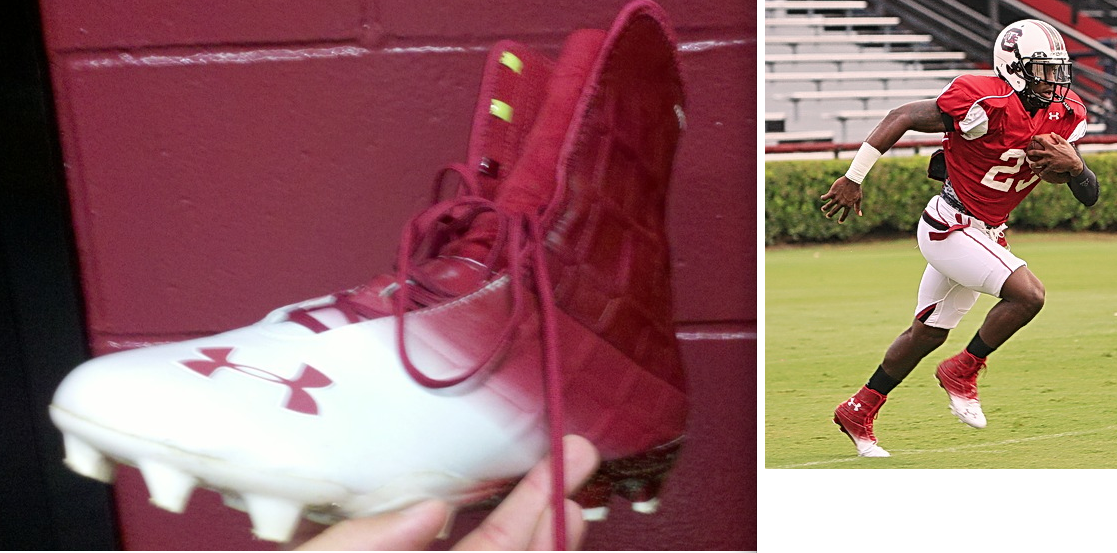
The lucrative relationships between shoe/apparel companies and universities is nothing new. Along with countless other advertisements claiming to be the official _____ of the University of ______, banners sporting the Nike swoosh or the Adidas stripes hang from the rafters or upper decks of arenas and stadiums all over the country. For a few million dollars, a young athlete’s brand devotion can be securely claimed by the time he leaves the university simply by the gear that has been provided.
This style of marketing has worked its way into high school as well. Just this season, Alcoa High School (and their seven consecutive Tennessee state championship football team) signed a deal with Under Armour for the exclusive rights to outfit their athletic teams. Nike signed a similar deal Maryville High School a few years earlier.
It’s as if college (and high school) administrators found a way around the amateur status of their athletes. Since collegian players can’t be sponsored by corporations, universities are more than happy to take that sponsorship for their brand. LaMichael James is at least six months from his first shoe deal, but Oregon is ready and waiting to capitalize on his ability in countless varieties of his #21 jersey. With kids everywhere from Texas to New York sporting Oregon green (or highlighter yellow or chocolate cake black or gun metal grey or.... whatever), the Ducks become a household name, James becomes a superstar, and Nike makes gobs of money through access to athletes it would otherwise not have. It’s a win-win-win.
This leads to other universities mimicking the same strategies, including the aforementioned Bulldogs, Terrapins, and Gamecocks. If a team wears a specialized jersey for a nationally televised game on ESPN, ABC, or CBS, by Monday morning the racks in the campus bookstore will be filled with these prom dress uniforms for the fans who want to slightly set themselves apart.
It’s difficult to argue against universities doing this. When I was in the seventh grade, I developed an obsession with North Carolina. I argued it was because I used to live there (we moved when I was six), but it was honestly because I saw their Nike gear every time I walked into Champs or Foot Locker. In my middle school mind, it represented the champion image I wanted. With Mack Brown leading a football resurgence at the time, the Carolina blue was too much to pass up. A Tar Heels shirt or jersey was a way for me to feel like the players I was watching on TV. The design of the shirt just made it easier.
The NCAA and college sports purists pride themselves on the amateurism of its athletes, but this is far from reality. Every time Andrew Luck steps on the field, he’s a Nike endorsement. When Marcus Lattimore cuts up the middle for 15 yards for the Gamecocks, the Under Armour logo will be just as prevalent as the garnet and black on his uniform. When an athlete signs with a university, he/she is signing with a footwear/apparel company as well.
But no harm, no foul. Everyone gets something in this symbiotic relationship, and the product on the field improves exponentially every year.
The problem arises when a football player tries to sell the jersey he received from this sponsorship (i.e. A.J. Green) or trade his complimentary gear he’s promoting for tattoos (i.e. Terrelle Pryor), his amateurism is conveniently brought up. The athlete is branded as selfish and greedy, while the university stands either as a victim or as a pillar of institutional sovereignty.
This issue joins a long line of NCAA regulations that have become nothing short of laughable. I won’t join the ranks that advocate for college athletes to be paid, but I do stand on the side of calling a spade a spade. If an athlete is an amateur, don’t make him into a billboard or a model for designer uniforms. The charade is embarrassing.
Thursday, August 18, 2011
Straight Cash, Homie.
For 13 professional years (and who knows how many years before) Randy Moss committed the unpardonable, cardinal sin of athletes. A transgression far more egregious to the world than any Pacman Jones “scrip” club brawl or Barry Bonds dirty syringes.
Moss, an athletic phoneme the likes of which we may never see again, was an absolute waste of talent. Period.
You couldn’t help but watch the Randy Moss train wreck, even if you wanted to turn in disgust.
“Randy has weighed his options and considered the offers and has decided to retire,” his agent Joel Segal said.
No “Thank you, fans”. No “It was an honor to play”. No “I want to spend more time with my family”. Moss didn’t even acknowledge earning millions as a football player was an enjoyable experience. Apparently his career wasn’t enough of an insult.
I realize I will never know even a shred of the answer to this question, but it begs considering: Why?
How do freakish talents like Moss, Albert Haynesworth, or Jamarcus Russell, find their way to the upper echelon of their sport only live out their careers as apathetic, puffed up egos in size eighteen shoes.
One would think the public disdain alone would drive someone to at least change their outward appearance. To go the Office Space route and give the illusion they’re working if only to appease the die-hard fan base. But for Moss and co., such rationale is met with bristled indignation.
There are disgruntled employees in every profession. Whether it’s Google or McDonald’s, someone will complain about every aspect of work and try to make every other employee’s work life miserable. Moss is the guy working in the next desk who wants to drag you into his world where no one seems to see the entitlement he’s been denied.
Where this is so much worse, though, is that Moss was given truckloads more than the discontent guy working next to you... and it was never close to enough to appease him.
In Bill Simmons June 13 post on Game 6 of the NBA finals, he wrote that Lebron might be the greatest, pure talent we will ever see, but he refuses to live up to his potential. This, he argues, is what ultimately drives the fires behind the Lebron hatred. Rather than step up to the moment and carry the fans to the glory they’re craving, Lebron hung around the perimeter and tried to look busy.
He later balked at reporters who dared question his talent and determination, roaring back with the obvious revelation that his life is better than everyone else’s.
In so many ways, Moss makes Lebron look like a first grade gym teacher. Lebron at least craves praise and approval. Moss seems to scoff at it.
It’s enough to make me wonder if some superstar athletes are so disconnected from reality that they can’t get out of their own way and enjoy their lives. Carlos Zambrano nearly walked away from $24 million because of an out of control temper tantrum and impulsive retirement claim after being ejected from a game against Atlanta. James Harrison can’t open his mouth without alienating half of his teammates, let alone the NFL brass. James would be a golden god had he stayed in Cleveland. And who knows the untold millions Tiger Woods lost because he chose flings with porn stars over his wife and kids.
For athletes who’ve been given every advantage, physically and monetarily, it’s amazing how often they stomp on their own success just when it’s there for the taking.
My favorite short story is Hemingway’s “Snows of Kilimanjaro”, which tells the story of a dying writer’s final thoughts as a gangrene infection slowly kills him. He begins reviewing his life, realizing the potential he traded for luxury and ease. The more he realizes his waste, the more he lashes out at his adoring female companion, blaming her wealth as his ultimate downfall. He dies bitter and angry, having never written what meant most to him.
Moss will now retire to a posh home, rubbing elbows with America’s elite and wealthy, and will never be forced to endure another day of thinking outside himself. But one day, whether tomorrow or 30 years from now, Moss will realize what he could have been. Millions of dollars can’t amend regret.
Moss, an athletic phoneme the likes of which we may never see again, was an absolute waste of talent. Period.
You couldn’t help but watch the Randy Moss train wreck, even if you wanted to turn in disgust.
“Randy has weighed his options and considered the offers and has decided to retire,” his agent Joel Segal said.
No “Thank you, fans”. No “It was an honor to play”. No “I want to spend more time with my family”. Moss didn’t even acknowledge earning millions as a football player was an enjoyable experience. Apparently his career wasn’t enough of an insult.
I realize I will never know even a shred of the answer to this question, but it begs considering: Why?
How do freakish talents like Moss, Albert Haynesworth, or Jamarcus Russell, find their way to the upper echelon of their sport only live out their careers as apathetic, puffed up egos in size eighteen shoes.
One would think the public disdain alone would drive someone to at least change their outward appearance. To go the Office Space route and give the illusion they’re working if only to appease the die-hard fan base. But for Moss and co., such rationale is met with bristled indignation.
There are disgruntled employees in every profession. Whether it’s Google or McDonald’s, someone will complain about every aspect of work and try to make every other employee’s work life miserable. Moss is the guy working in the next desk who wants to drag you into his world where no one seems to see the entitlement he’s been denied.
Where this is so much worse, though, is that Moss was given truckloads more than the discontent guy working next to you... and it was never close to enough to appease him.
In Bill Simmons June 13 post on Game 6 of the NBA finals, he wrote that Lebron might be the greatest, pure talent we will ever see, but he refuses to live up to his potential. This, he argues, is what ultimately drives the fires behind the Lebron hatred. Rather than step up to the moment and carry the fans to the glory they’re craving, Lebron hung around the perimeter and tried to look busy.
He later balked at reporters who dared question his talent and determination, roaring back with the obvious revelation that his life is better than everyone else’s.
In so many ways, Moss makes Lebron look like a first grade gym teacher. Lebron at least craves praise and approval. Moss seems to scoff at it.
It’s enough to make me wonder if some superstar athletes are so disconnected from reality that they can’t get out of their own way and enjoy their lives. Carlos Zambrano nearly walked away from $24 million because of an out of control temper tantrum and impulsive retirement claim after being ejected from a game against Atlanta. James Harrison can’t open his mouth without alienating half of his teammates, let alone the NFL brass. James would be a golden god had he stayed in Cleveland. And who knows the untold millions Tiger Woods lost because he chose flings with porn stars over his wife and kids.
For athletes who’ve been given every advantage, physically and monetarily, it’s amazing how often they stomp on their own success just when it’s there for the taking.
My favorite short story is Hemingway’s “Snows of Kilimanjaro”, which tells the story of a dying writer’s final thoughts as a gangrene infection slowly kills him. He begins reviewing his life, realizing the potential he traded for luxury and ease. The more he realizes his waste, the more he lashes out at his adoring female companion, blaming her wealth as his ultimate downfall. He dies bitter and angry, having never written what meant most to him.
Moss will now retire to a posh home, rubbing elbows with America’s elite and wealthy, and will never be forced to endure another day of thinking outside himself. But one day, whether tomorrow or 30 years from now, Moss will realize what he could have been. Millions of dollars can’t amend regret.
Subscribe to:
Posts (Atom)