Far be it from me to tell SEC fans to be reasonable. We’re a zealous bunch when it comes to football, and having a losing team is damn near the equivalent to wearing the “cone of shame.” This unrelenting passion is what pays Nick Saban $5 million per, has Gene Chizik on the hot seat less than two years removed from a national title, and it’s what motivates this guy. And this guy.
But this passion also breeds a culture where adaptation is seen as weakness and tradition is carried like a flag into battle. Even if that tradition is fading.
Such is the case of Derek Dooley at Tennessee.
After being about the eighth offer to replace one-and-done Lane Kiffin, Dooley’s two-plus years in Knoxville have been disastrous by Tennessee standards. He’s 0-12 against ranked teams and winless against conference rivals Florida, Alabama, South Carolina, and Georgia. He’s yet to earn a conference win on the road, and the 26 game win streak over Kentucky ended last season.
Ugh.
But for those clamoring for Dooley’s head, it’s time to wake up and face reality. The school and fan base need to redefine what it means to be a national power in modern college football.
It was easy to get spoiled after decades of winning the old way, when the Tennessee brand carried it’s own weight. But that world has gone the way of cable tv and paper back books. Now, college football is being shaped more by flashy uniforms and YouTube videos than anything you might consider traditional. Play in front of 102,000 in Neyland Stadium? Please... Try playing USC while wearing state of the art apparel fresh off the design floor at Nike in front of a TV/online audience of millions with LeBron and D Wade on the sidelines at Autzen Stadium while trending on Twitter.
This is the new college football; an NFL D-League where recruits are lured by amenities and “cool”-factor. Sell a high schooler on tradition? You might as well give them a Mel Torme album for its cultural significance.
Comparatively, Tennessee purists seem more like bitter old men stashing money in their mattress than forward thinking investors. Alternate uniforms? It’s happened only once and radio stations and message boards lit up with fans appalled by the change. (It was ironically the last time the team beat a ranked opponent.) Modern facilities? UT’s brand new, $45 million updates pale in comparison to Southern Cal’s $70 million John McKay Center. Recruiting without these advantages? Dooley has been left to rely on his charisma and personality... and we all know what that’s like...
Therefore, the university must decide what it wants to be. To maintain the present course is to accept a future somewhere in the median. But if years of invites to the Music City Bowl are ahead, then blaming Dooley for losing to programs who’ve made far greater investments into winning is asinine. No individual coach is powerful enough to overcome odds like these. Even those with household names like Saban and Spurrier need major commitments from their respective universities to succeed. Without this, they might as well be coaching a high school team to state titles.
I don’t believe Dooley will ever be looked upon as a football genius or as a legend like his father, but neither will 99 percent of all coaches. If he’s fired this season, I’ll feel terribly for him because doesn’t deserve it. If the university wants to win now, then good luck making another Kiffin-esque hire. Desperation can lead to some very poor decisions. Just ask Arkansas.
Showing posts with label Oregon Uniforms. Show all posts
Showing posts with label Oregon Uniforms. Show all posts
Thursday, October 4, 2012


Tuesday, September 6, 2011
Fashion Week
Even if Georgia had beaten Boise St., they should have forfeited on principal alone.
Trading in their traditional red and black uniforms for the gaudy Nike Pro Combat monstrosities didn’t help in a 35-21 lose to begin a season where they were declared this year’s Auburn. After today, those jerseys will be nothing more than fodder for talk radio jokes and filler for alumni fundraising auctions.
Having specialty uniforms for big games is all the rage in college football. The Oregon Ducks, as part of a 15 year marketing plan by Nike, have revolutionized their program by creating an image. “Throwback” jerseys are finding their way to even the most established programs, and ESPN has devoted a section of their website to “Uni Watch”. Somewhere, Dick Butkus and JIm Brown are gagging at the thought of this.
I’m not going to get into a rant on the amount of money generated through college football or whether or not collegian athletes should be paid. The topic has been discussed ad nauseam. However, I do find it interesting how easily we’ve all come to accept the extremes that college football has become corporatized.
Thanks to Nike and Under Armor, college football is as much about the image created as it is the game itself. In a recent article from Michael Kruse on Grantland, Nike CEO and Oregon alum Phil Knight devised a plan to generate nationwide attention for a program that had spent the better part of a century at the bottom of the college football world. Through branding and marketing designed for 17 year old athletes, Oregon went from entrenched in mediocrity to football power. Recruits flocked (pun intended) to the university that was pushing the limits of how close a football uniform could resemble Batman’s outfit.
The plan worked perfectly. Oregon finished a near perfect season, and superstar running backs LaMichael James and LaGarret Blount referenced openly the Ducks’ cutting edge attire as a contributing factor in their decision to play in Eugene.
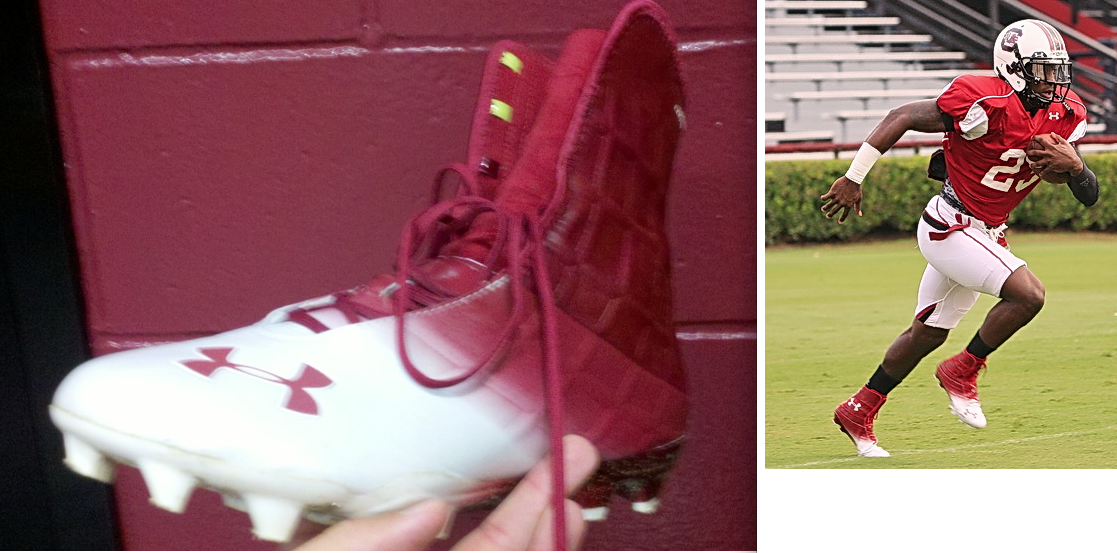
And the trend is spreading. Under Armour CEO Kevin Plank, and Maryland football alum, has spearheaded their own futuristic design for the Terrapins, including those worn against Miami that looked like the state flag threw up. Under Armour has also outfitted South Carolina with five different uniform possibilities and a cleat/ankle brace that “Uni Watch” said allowed the shoe logo to not be covered with tape.
The lucrative relationships between shoe/apparel companies and universities is nothing new. Along with countless other advertisements claiming to be the official _____ of the University of ______, banners sporting the Nike swoosh or the Adidas stripes hang from the rafters or upper decks of arenas and stadiums all over the country. For a few million dollars, a young athlete’s brand devotion can be securely claimed by the time he leaves the university simply by the gear that has been provided.
This style of marketing has worked its way into high school as well. Just this season, Alcoa High School (and their seven consecutive Tennessee state championship football team) signed a deal with Under Armour for the exclusive rights to outfit their athletic teams. Nike signed a similar deal Maryville High School a few years earlier.
It’s as if college (and high school) administrators found a way around the amateur status of their athletes. Since collegian players can’t be sponsored by corporations, universities are more than happy to take that sponsorship for their brand. LaMichael James is at least six months from his first shoe deal, but Oregon is ready and waiting to capitalize on his ability in countless varieties of his #21 jersey. With kids everywhere from Texas to New York sporting Oregon green (or highlighter yellow or chocolate cake black or gun metal grey or.... whatever), the Ducks become a household name, James becomes a superstar, and Nike makes gobs of money through access to athletes it would otherwise not have. It’s a win-win-win.
This leads to other universities mimicking the same strategies, including the aforementioned Bulldogs, Terrapins, and Gamecocks. If a team wears a specialized jersey for a nationally televised game on ESPN, ABC, or CBS, by Monday morning the racks in the campus bookstore will be filled with these prom dress uniforms for the fans who want to slightly set themselves apart.
It’s difficult to argue against universities doing this. When I was in the seventh grade, I developed an obsession with North Carolina. I argued it was because I used to live there (we moved when I was six), but it was honestly because I saw their Nike gear every time I walked into Champs or Foot Locker. In my middle school mind, it represented the champion image I wanted. With Mack Brown leading a football resurgence at the time, the Carolina blue was too much to pass up. A Tar Heels shirt or jersey was a way for me to feel like the players I was watching on TV. The design of the shirt just made it easier.
The NCAA and college sports purists pride themselves on the amateurism of its athletes, but this is far from reality. Every time Andrew Luck steps on the field, he’s a Nike endorsement. When Marcus Lattimore cuts up the middle for 15 yards for the Gamecocks, the Under Armour logo will be just as prevalent as the garnet and black on his uniform. When an athlete signs with a university, he/she is signing with a footwear/apparel company as well.
But no harm, no foul. Everyone gets something in this symbiotic relationship, and the product on the field improves exponentially every year.
The problem arises when a football player tries to sell the jersey he received from this sponsorship (i.e. A.J. Green) or trade his complimentary gear he’s promoting for tattoos (i.e. Terrelle Pryor), his amateurism is conveniently brought up. The athlete is branded as selfish and greedy, while the university stands either as a victim or as a pillar of institutional sovereignty.
This issue joins a long line of NCAA regulations that have become nothing short of laughable. I won’t join the ranks that advocate for college athletes to be paid, but I do stand on the side of calling a spade a spade. If an athlete is an amateur, don’t make him into a billboard or a model for designer uniforms. The charade is embarrassing.
Subscribe to:
Posts (Atom)